
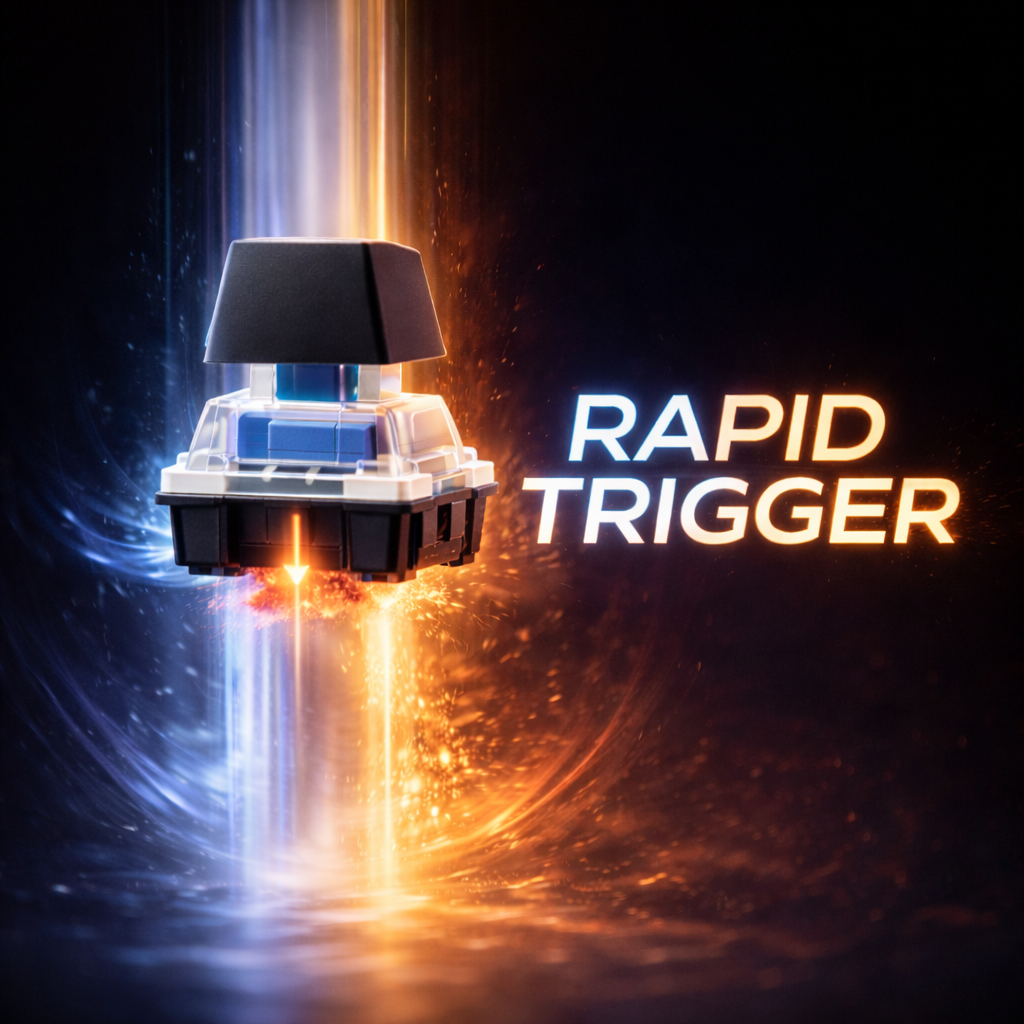
What Is a Magnetic (Hall-Effect) Keyboard?
Before understanding Rapid Trigger, we first need to answer a fundamental question:
What is a magnetic (Hall-effect) keyboard?
A magnetic keyboard is essentially a keyboard based on the Hall Effect.
Traditional mechanical keyboards rely on metal contacts and physical circuit closure. Magnetic keyboards work differently. Each switch contains a magnet and a Hall sensor.
When a key is pressed, the magnet’s position changes.
The Hall sensor detects changes in the magnetic field in real time.
The system then precisely calculates the exact travel depth of the key.
In other words, a magnetic keyboard does not simply read “pressed” or “not pressed.”
It reads how far the key is pressed.
This allows keyboards to evolve from:
- Digital input (“on / off”)
- to continuous analog input based on real-time position
And Rapid Trigger is built directly on this foundation.
What Is Rapid Trigger?
Why Magnetic Keyboards Are Redefining “Fast”
1. From “Pressing” to “Actuating”: Keyboards Have Always Been Slow
On a traditional mechanical keyboard, every key has a fixed actuation point.
You must press the key down to a specific depth before the signal is triggered.
What does this mean in practice?
- Press too lightly: nothing happens
- Don’t release high enough: the key cannot trigger again
- During rapid tapping: physical delay and return lag occur
For everyday typing, these limitations may not matter much. But in FPS, MOBA, and rhythm games, where input timing is critical, these delays become extremely noticeable.
2. The Core Change of Magnetic Switches: No More “Contact Points”
Magnetic keyboards fundamentally change how key input works.
Instead of relying on metal contacts closing a circuit, magnetic switches use magnetic field changes combined with a Hall sensor to track key position continuously.
This introduces two essential changes:
- The key signal becomes a continuous analog signal
- The actuation point is no longer a single fixed position, but an adjustable range
This is exactly what makes Rapid Trigger possible.
3. What Exactly Is Rapid Trigger?
In one sentence:
Trigger where you press. Reset where you release. No fixed travel limits.
With Rapid Trigger enabled:
- You no longer need to release the key to a fixed height
- Every small finger movement is detected in real time
- Triggering and resetting happen almost simultaneously
The faster your finger moves, the faster the system responds.
4. Rapid Trigger Is Not Just “Faster” — It Is More Precise
Many people assume Rapid Trigger is simply about speed. In reality, its biggest advantage is control precision.
In games, this translates to:
- Cleaner and more immediate stops
- Finer movement adjustments
- More consistent rapid tapping
- Fewer unintended inputs and “sticky” movements
In FPS scenarios such as peeking, strafing, and stop-and-shoot, the advantage of Rapid Trigger becomes especially obvious.
5. Why Competitive Players Are Choosing Magnetic Switches + Rapid Trigger
In high-level competitive play, matches are often decided by milliseconds.
Rapid Trigger makes keyboard input behave closer to the player’s fingers themselves:
- No waiting for metal leaf springs
- No waiting for mechanical rebound
- No reliance on tolerance or debounce delays
You release — it stops.
You press — it moves.
This is why more professional players and hardcore enthusiasts are switching to Hall-effect keyboards with Rapid Trigger as their main setup.
6. Rapid Trigger Is Not a Gimmick — It Is an Evolution of Input
Rapid Trigger is not about creating specification hype. It solves a long-standing problem:
Keyboards no longer limit your control.
When input is no longer constrained by physical structure, what determines performance is no longer the hardware — but your reaction, timing, and decision-making.
Share:
What is Gasket Mount?