
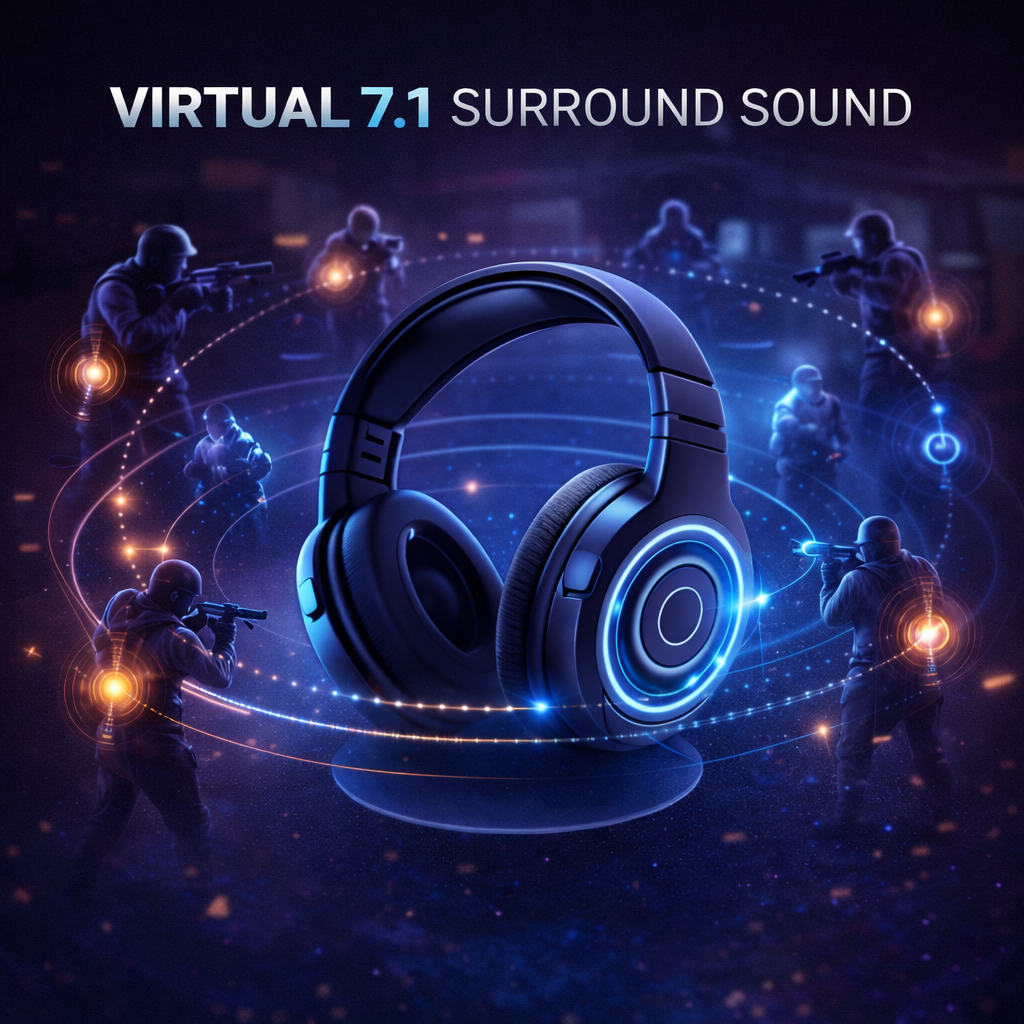
When shopping for gaming headsets, “virtual 7.1 surround sound” is almost unavoidable. Many players naturally assume: the more channels, the more accurate the positioning, and the better the FPS performance.
But in practice, it’s often the opposite.
- What virtual 7.1 on gaming headsets is
- How virtual 7.1 “creates” a sense of space
- Why 7.1 is often not the better choice in FPS games
1. What Is “Virtual 7.1” on a Gaming Headset?
Let’s make the most important point first: the “7.1” printed on most gaming headsets is almost always “virtual 7.1,” not true 7.1.
1) True 7.1 vs. Headset 7.1: What’s the Difference?
In a home theater, 7.1 means: 7 physical speakers placed around you + 1 subwoofer. Sound comes from real, physical positions, and your ears receive natural spatial cues.

Headphones, however, only have two drivers (left and right). There are no multiple physical sound sources, so headphones cannot produce “true 7.1.” They can only rely on algorithms to “simulate” it.

In other words: 7.1 on headphones isn’t “more physical channels”—it’s “extra processing applied to stereo.”
2) What Is Virtual 7.1, Really?
Virtual 7.1 is essentially: using digital signal processing (DSP) to simulate direction and space on top of stereo. It leverages how humans localize sound (for example: left/right loudness differences, arrival-time differences, and frequency cues), then recalculates the original audio so your brain “believes” sounds are coming from different directions.
Common techniques include:
- Adding small delays (to suggest distance and front/back)
- Adjusting left/right level balance (to shift perceived direction)
- Shaping frequency response (to mimic occlusion/distance)
- Introducing room reverb (larger stage, stronger “surround” feel)
- Reconstructing phase cues (more obvious depth and layering)
The goal is simple: create a “spatial illusion.”
2. What Are the Advantages of Virtual 7.1?
Virtual 7.1 is not a “useless feature.” It’s often very enjoyable in these scenarios: single-player story games, open-world titles, RPGs, movies/TV, and content where ambience and atmosphere matter a lot.
This video is technically supported by IAA Sonic. To watch the full video, please visit: https://immersiveaudioalbum.com/sonic-brand/. If your headset supports virtual 7.1, please enable it and compare the difference before and after turning it on.
- A wider soundstage
- Stronger surround “envelopment”
- Richer environmental details
- A clear boost in immersion
So if virtual 7.1 feels “wow” the first time you turn it on—that’s normal. Its job is to make you feel more immersed.
3. Why Virtual 7.1 Often Isn’t Ideal for FPS
Key point: the core needs of FPS do not match the design goal of virtual 7.1.
1) FPS Needs “Precision,” Not “Envelopment”
In FPS, sound’s most important job is to help you quickly judge: enemy direction, distance, upstairs/downstairs, and whether they’re hugging a wall or behind cover.
That depends on clear, clean, direct details.
But virtual 7.1 often widens the stage, adds reverb and extra layering, and reshapes cues. A common result is:
- It sounds more 3D and more “cinematic”
- But directional judgment becomes easier to misread or feel “blurry” (especially diagonal rear and vertical cues)
2) Processing Can “Soften” Details and Reduce Separation
Virtual 7.1 is a second round of processing, which can soften footstep edges, let small cues get masked by ambience, and reduce separation.
In competitive FPS, these “better-sounding” changes can actually reduce judgment speed and accuracy.
3) Extra Algorithms Can Add Slight Latency or Distortion
Virtual 7.1 requires real-time computation (mixing, delay calculation, phase shaping). On some devices or in certain wireless chains/modes, it can introduce slight latency or make the response feel less “snappy,” which weakens confident positioning.
4) Many FPS Games Are Designed Around Stereo/Binaural Logic
Many FPS titles (especially competitive ones) are tuned around stereo/binaural localization: more direct left-right intensity, cleaner layering, and predictable cues.
Forcing virtual 7.1 can overwrite those relationships—so you may “hear it,” but not judge it correctly.
4. Why Most Pro Players Don’t Use 7.1
If you watch pro players or high-skill players, you’ll notice they tend to prefer clean, clear stereo.
In FPS, “more realistic space” does not automatically mean “more useful competitive information.”
The reason is simple: once footsteps are clear and layers are well-defined, the brain builds a stable “mapping” through training—often more reliable than a general-purpose algorithm.
5. How to Choose: One Table Summary
| Use case | Recommended mode |
|---|---|
| FPS / Competitive matches | Stereo |
| Footstep-focused play | Stereo + disable sound enhancements |
| Single-player / Story / Open world | Enable virtual 7.1 |
| Movies / TV | Enable virtual 7.1 |
يشارك:
Three Types of Mechanical Keyboard Switches